Neurodiversity in my practice…
I specialise in working with Autism and ADHD, but stay informed and knowledgeable about many other forms of neurodiversity.
I suspect I am autistic myself, and am in the process of pursuing a diagnosis.
I recognise neurodiversity as a natural part of being human, value it, recognise the challenges that can come with it, and understand how neurodiversity interacts with mental health, identity, trauma, and wellbeing.
I will work with you to make sure you are safe to be your authentic self in our shared space, talk to you about what needs and adjustments you may have in order to be able to access counselling in a way that works for you.
Neurodiversity in politics:
In recent years, neurodiversity has come under attack internationally at a political level, with much conversation focussing on “overdiagnosis”, whilst also belittling or actively attacking the neurodivergent community. These attacks have been wholly based in misinformation, opinion, and bias. This has created a sense of division, isolation, and fear in many people.
I stand with the neurodivergent community, and will continue to do so. My practice will always be a safe place for you to be your full and authentic self.
Neurodiversity
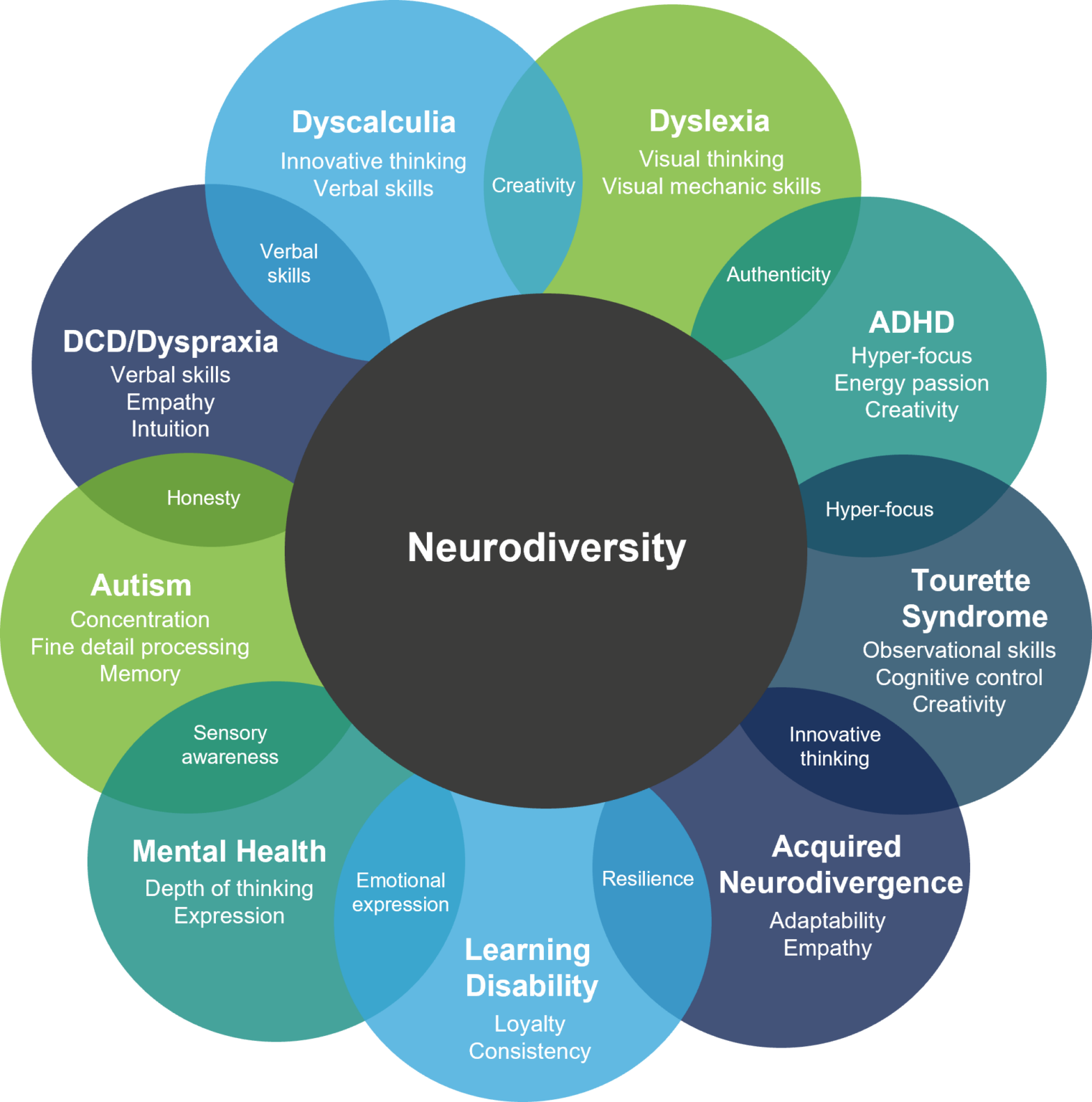
“Neurodiversity” is a term that represents all forms of neurological ‘difference’.
The term refers to Autism Spectrum Disorder (ASD), Attention Deficit Hyperactivity Disorder (ADHD), dyslexia, and many other conditions and diagnoses, thought to make up 15-20% of the population.
Whilst being ‘different’ to a majority of the population, being neurodivergent is a natural part of the human experience, and existed long before a name or diagnosis for these differences did.
It can come with unique challenges, difficulties, and many types of neurodiversity are recognised as disabilities because of this.
You can learn more about neurodiversity here.
Autism
Autism is a neurodivergence that is characterised by interacting and experiencing the world differently, in ways that a person thinks, feels, and communicates. This can mean that socialising is confusing or tiring, bust places might be overwhelming, holding intense interests, or using repeated movements or actions to keep calm.
Autism is recognised as a “spectrum”, meaning that whilst many autistic people share common traits, these will impact each individual uniquely and in different ways.
It is not a learning disability or mental health condition; but autistic people are more likely to also have a learning disability and experience mental health problems.
When growing up as an autistic person, diagnosed or otherwise, there can be pressure to perform ‘masking’. This is the process of hiding autistic behaviours or traits in order to ‘pass’ as neurotypical. The process of masking is incredibly difficult, and can contribute to mental health problems.
Autism is genetic; this means that it has no ‘cause’. Famously, it has been claimed that vaccines or even some medications during pregnancy cause autism - this is false.
Autism is a complex neurodevelopmental difference, but it is a natural phenomena.
You can learn more about Autism from the National Autistic Society.
ADHD
ADHD is a neurodivergence that is characterised through behaviour: Persons with ADHD show a consistent pattern of inattention and/or hyperactivity-impulsivity that will interfere with their daily functioning. It is thought to be diagnosed in roughly 5% of children, and in 3-4% of adults.
ADHD is usually presented in one of three ways:
Combined presentation (50-75%)
Predominantly Inattentive presentation (20-30%)
Predominantly Hyperactive-Impulsive presentation (15%)
ADHD may present as difficulty to give attention to details, struggling to focus on tasks or play, trouble organising, losing items, fidgeting, difficulty staying still, “blurting out” answers before a question is finished, and many other behaviours.
With all of this combined, ADHD can be disabling for an individual, making daily life incredibly difficult. It can impact on relationships, socialising, and confidence.
ADHD, like other neurodivergences, has no one ‘cause’. It is considered to be mostly genetically determined, with some environmental factors possibly contributing to this.
Like Autism, growing up as a person with ADHD can have unique challenges, trauma, and experiences attached. It is also a natural part of the human experience.
You can learn more about ADHD from ADHD UK.